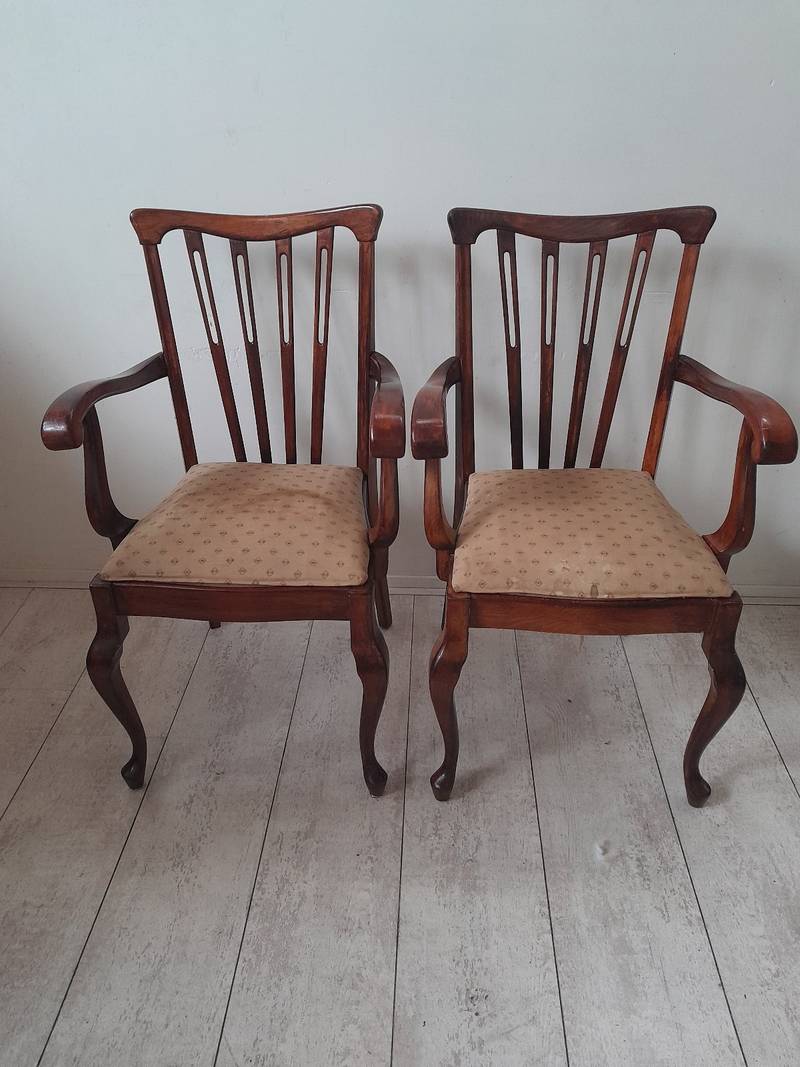
Pair of George III Style Mahogany Armchairs
Estimated value
$400 - $1,200Rarity
Average(4/10)Category
InteriorEra
Late 18th to Early 19th Century (George III Style), potentially later reproductionOrigin
United KingdomAuthenticity
PAIR OF GEORGE III STYLE MAHOGANY ARMCHAIRS: IDENTIFICATION
This pair of armchairs exhibits characteristics often associated with the late 18th-century George III period in English furniture design, particularly a 'Gothic Chippendale' or 'Transitional Chippendale' influence. The pierced splat back with its gothic-arch inspired openings, combined with the shaped crest rail and outward-flaring arms, are typical of the period when mahogany was the predominant timber. The cabriole legs ending in pad feet suggest an earlier Georgian influence or a continuation of traditional forms. The upholstered drop-in seats, though likely not original to the period, are a common feature of this style.
PRODUCTION PERIOD
SCARCITY
Typical antique shop fare. Requires some searching but regularly available. This is where most genuine antiques fall.
Typical Characteristics
- Standard antique shop items
- Regularly available
- Moderate collector interest
Confidence Factors
- Without examination of joinery (e.g., drawer construction, if applicable, or unseen frame joints) and secondary woods, definitive dating is difficult, as this style was reproduced extensively.
- The overall finish and minor details might point to a high-quality 19th or early 20th-century reproduction rather than a true 18th-century piece.
- The upholstery is clearly not original and its poor condition means it provides no clues about the chair's history beyond being a replacement.
Expert review recommended. Consider consulting a specialist before making purchasing decisions.
DESIGN HISTORIAN'S TAKE
Furniture Historian & Restoration Specialist
The visible stylistic elements strongly point towards a George III or Chippendale Revival style. However, without inspecting joinery, secondary woods, and hardware, a precise dating and definitive authenticity assessment between an original and a well-made reproduction remains challenging.
KEY EVIDENCE
- 1Pierced splat back with Gothic-inspired openings is characteristic of George III / Chippendale style.
- 2Mahogany or stained hardwood construction, a favored timber for quality furniture in the late 18th century.
- 3Cabriole legs terminating in pad feet, a design motif prevalent in earlier Georgian furniture and sometimes retained in later styles.
- 4Outward-flaring arms with a comfortable, rounded profile.
- 5The drop-in seat construction is typical for chairs intended for formal upholstered seating.
UNCERTAINTIES
- •Lack of visible joinery details makes it difficult to distinguish between an 18th-century original and a high-quality later reproduction.
- •The overall consistency of the wood tone across both chairs indicates either excellent preservation or possibly a refinish/later production.
WHAT WOULD IMPROVE CERTAINTY
- →Provide clear, high-resolution photographs of the underside of the chairs to examine the frame construction and secondary woods.
- →Submit close-up images of any visible joints, especially where arms meet the back and seat rail, and any evidence of original hardware.
- →Capture detailed images of the finish to assess for originality versus later refinishing.
- →Measure dimensions to compare with known period examples.
CONDITION & GRADE
Condition
The overall condition appears fair, with visible wear to the finish, particularly on the arms and edges. The upholstery on the drop-in seats shows significant staining, discoloration, and wear, indicating a need for replacement. Structural integrity seems generally sound from the images, though minor joint looseness is common in older pieces of this type.
DESIGN MARKET VALUE
Updated: Feb 27, 2026
- Market comparables from auctions & retail
- Condition, completeness & craftsmanship
- Current collector demand & trends
- Low = quick sale, high = patient seller
For informational purposes only, not a formal appraisal.
ABOUT INTERIOR
Furniture, lamps, lighting, chandeliers, decorative objects for the home.
Interior value and rarity guideSHARE THIS CURIOSITY
Have your own curiosities to discover?
Scan Your Curiosity
COMMENTS