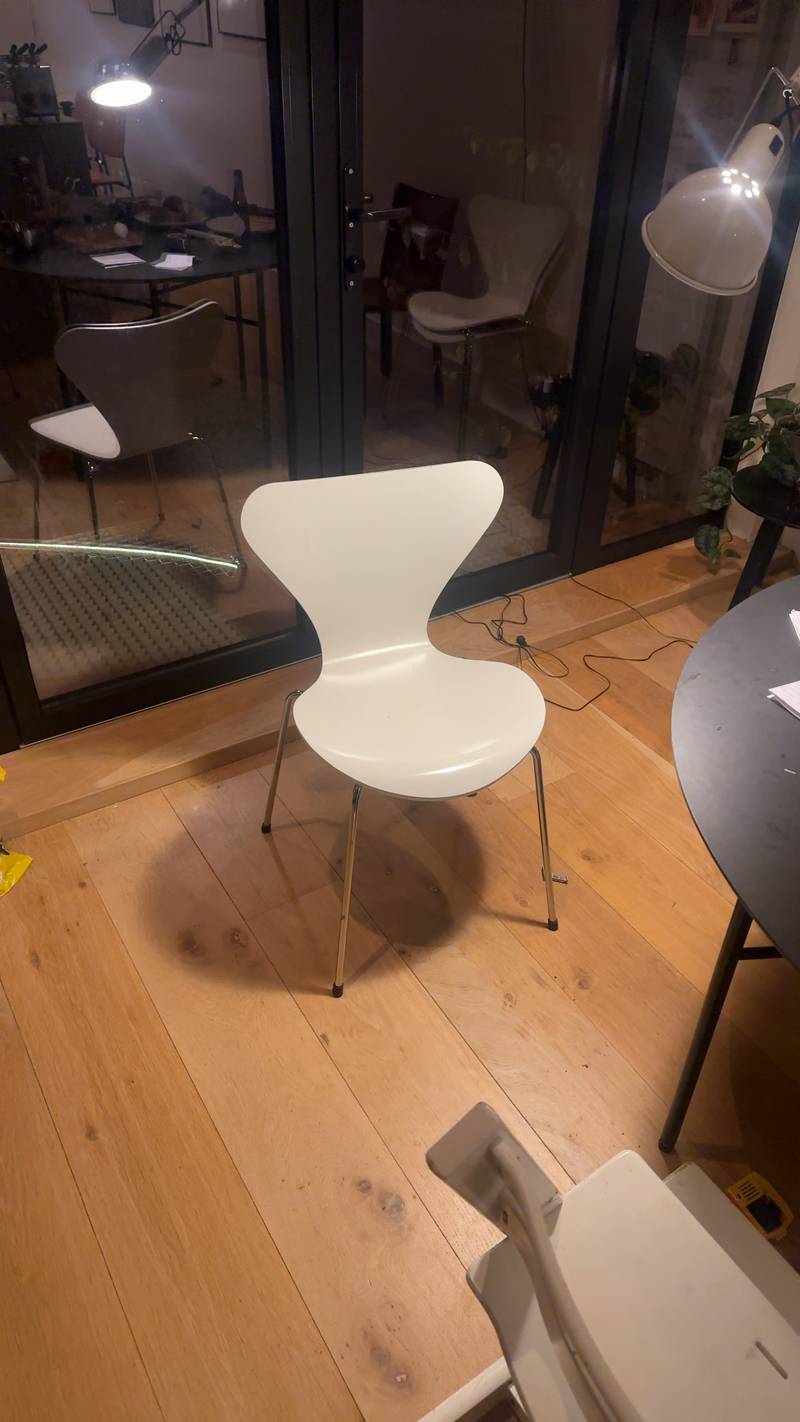
Arne Jacobsen - Series 7 Chair (Fritz Hansen, Model 3107) White Lacquered Plywood
Estimated value
$250 - $450Rarity
Ordinary(3/10)Category
InteriorBrand
Fritz HansenEra
Circa 1990-2010Origin
DenmarkArtist / Creator
Arne JacobsenAuthenticity
ARNE JACOBSEN - SERIES 7 CHAIR (FRITZ HANSEN, MODEL 3107) WHITE LACQUERED PLYWOOD: IDENTIFICATION
Original Model 3107 'Series 7' side chair featuring a pressure-molded sliced veneer shell in a white lacquered finish. The chair is supported by a four-legged base of chrome-plated steel tubes. The underside reveals the integrated plastic housing assembly with the manufacturer's mark 'BY FRITZ HANSEN' and 'MADE IN DENMARK' embossed in a circular configuration, which is standard for post-1960s production.
CROSS-CULTURAL PARALLELS
Where This Object Echoes
The chair embodies the 'Democratic Design' philosophy of the post-war era, prioritizing mass-production efficiency without sacrificing organic form.
Ritual & Ceremonial Use
- •Often used in corporate and domestic settings as a symbol of mid-century sophistication and organizational status.
Meaning Through Time
A radical symbol of 'Space Age' technological progress in wood-bending.
A ubiquitous design staple of high-end minimalist interior styling.
PRODUCTION PERIOD
COLLECTOR NOTES
The Series 7 remains the best-selling chair in the history of the Fritz Hansen company with over 5 million units sold globally since 1955.
SCARCITY
Standard antiques commonly found at estate sales and flea markets. Plentiful supply meets modest demand.
Typical Characteristics
- Moderate production runs
- Common at estate sales
- Entry-level collectibles
Confidence Factors
- Manufacturer mark 'BY FRITZ HANSEN' and 'MADE IN DENMARK' embossed in plastic housing is consistent with authentic production
- Construction geometry of the seat-to-back transition matches Jacobsen's specific curves
- Leg cap and spacer design is consistent with late 20th-century Fritz Hansen standards
DESIGN HISTORIAN'S TAKE
Furniture Historian & Restoration Specialist
Identification is high due to the clear presence of the manufacturer's mark on the under-cap and the distinct silhouette which is difficult to replicate with precision in knock-offs.
KEY EVIDENCE
- 1Authentic 'Made in Denmark' and 'By Fritz Hansen' embossed underside mark
- 2Shell thickness and curve radius consistent with steam-bent plywood prototypes
- 3Standard chrome tube gauge and weld points at the junction housing
- 4Presence of age-consistent oxidation on the chrome supports
UNCERTAINTIES
- •Slight yellowing of the white lacquer may indicate UV exposure or non-original refinishing, though likely just age.
WHAT WOULD IMPROVE CERTAINTY
- →Examine the very bottom of the leg feet; authentic versions usually feature a specific black plastic or rubber glide with a slight internal curve.
- →Measure seat height; standard is approximately 43 cm, though 46 cm versions exist for modern table heights.
CONDITION & GRADE
Grading breakdown
Structural integrity appears sound; value is slightly tempered by visible surface wear and oxidation on the lower legs.
Condition
Minor surface scuffing visible on the seat shell and slight oxidation pitting appearing on the chrome legs. The plastic under-cap is intact without visible stress fractures, a common site of failure in older units.
Weight & feel
Approximately 4 kg, characterized by a lightweight but rigid construction typical of Danish teak and plywood engineering.
DESIGN MARKET VALUE
Updated: May 11, 2026
Single Series 7 chairs in standard colors frequently realize $250-$400 at auction houses like Wright or through 1stdibs dealers.
Who buys this
Mid-century modern enthusiasts and interior designers specializing in Scandinavian aesthetics.
What increases value
- •Presence of authentic Fritz Hansen embossing
- •Originality of the white lacquer finish
- •Structural stability of the shell-to-base connection
What lowers value
- •Visible pitting on chrome reduces value for pristine collectors
- •Potential fine cracks at the 'waist' of the chair where bending stress is highest
What makes top-tier examples
- •Rare wood veneers like Rio Rosewood (pre-CITES)
- •Early metal-plate production models from the late 1950s
Grade & condition
Surface scuffs, lacquer chips, leg oxidation, and shell flexibility.
Rarity & demand
For informational purposes only, not a formal appraisal.
ABOUT INTERIOR
Furniture, lamps, lighting, chandeliers, decorative objects for the home.
Interior value and rarity guideSHARE THIS CURIOSITY
Have your own curiosities to discover?
Scan Your Curiosity
COMMENTS