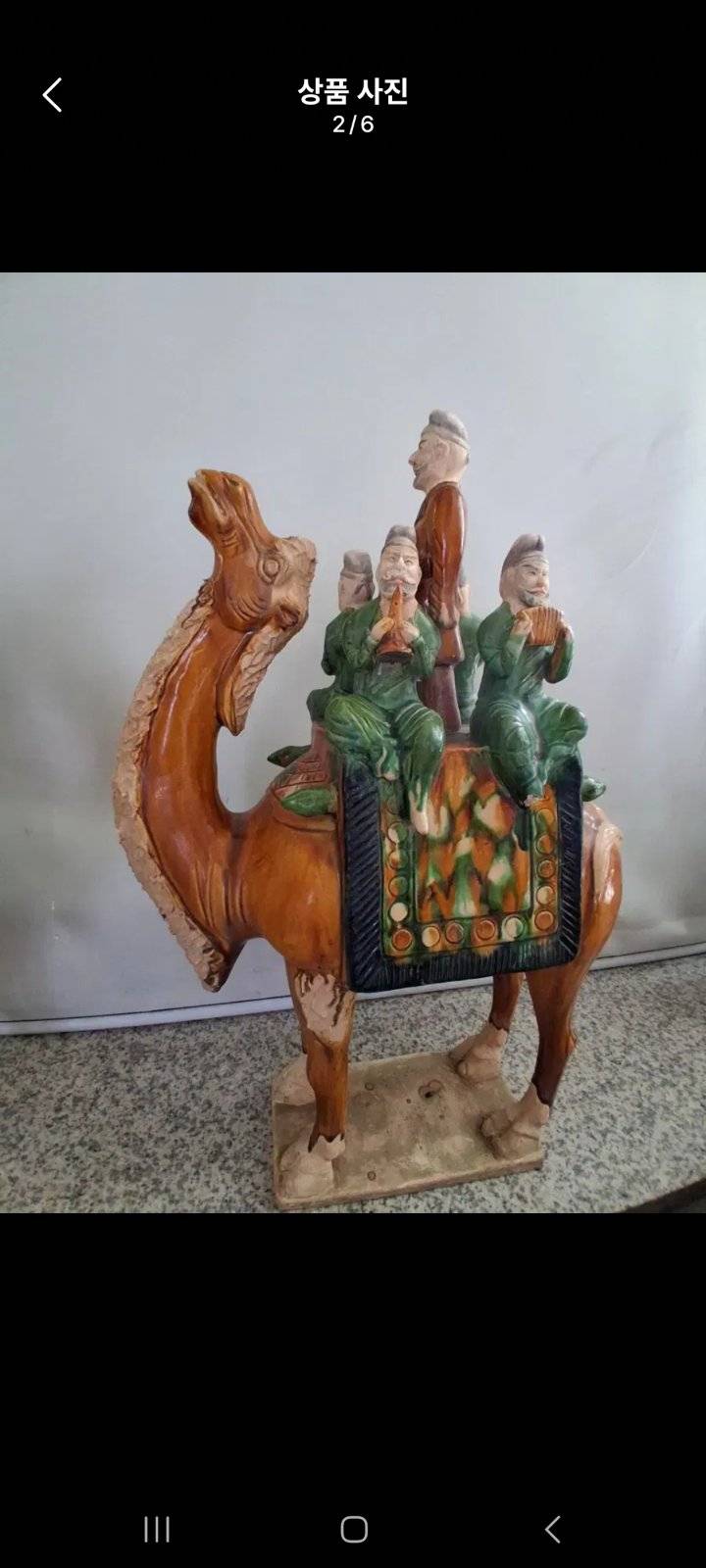
Reproduction Tang-Style Sancai Camel with Musicians
Estimated value
$75 - $200Rarity
Common(2/10)Category
Ceramics & PotteryEra
Late 20th Century (circa 1980-2010)Origin
ChinaAuthenticity
REPRODUCTION TANG-STYLE SANCAI CAMEL WITH MUSICIANS: IDENTIFICATION
Earthenware sculptural group depicting a Bactrian camel carrying five Central Asian musicians on a rectangular saddle blanket. The piece is modeled after 8th-century Tang Dynasty mingqi (tomb figures). It employs sancai (three-color) low-fired lead glazes in amber, copper-green, and a clear glaze over white slip. The figures' heads and the camel's mane are left unglazed, showing a buff-colored clay body with traces of cold-painted pigment on the facial features. The base is an unglazed rectangular slab, revealing a pale, clean earthenware paste indicative of modern slip-casting or mold-pressing rather than ancient hand-modeling.
COLLECTOR NOTES
A genuine 8th-century Tang Dynasty sancai camel with musicians, excavated in 1957 near Xi'an, measures 58.4 cm in height and is housed in the National Museum of China.
SCARCITY
Older mass-produced items still widely available. Easy to find on eBay, antique malls, and estate sales in large quantities.
Typical Characteristics
- Mass produced historically
- High survival rate
- Readily available everywhere
Confidence Factors
- Complete absence of burial degradation, silvering, or genuine iridescence on the lead glaze
- Unglazed base and facial areas show clean, modern buff clay lacking ancient soil penetration
- Modeling of the figures appears slightly stiff and standardized compared to period Tang examples
Expert review recommended. Consider consulting a specialist before making purchasing decisions.
CERAMICIST'S ASSESSMENT
Ceramics Historian & Kiln Specialist
The visual markers of modern reproduction pottery—namely the uncorrupted glaze surface, clean buff paste, and lack of burial accretions—are clearly discernible. Authentic Tang sancai wares of this complexity are strictly museum or premiere auction tier.
KEY EVIDENCE
- 1High-gloss un-degraded lead glazes in copper-green and iron-amber
- 2Clean buff earthenware paste visible on the unglazed base and figures' heads
- 3Korean product photo UI overlay indicates contemporary e-commerce listing
- 4Precise replication of a known museum-housed artifact
UNCERTAINTIES
- •Item presents as a Tang Dynasty antiquity but surface chemistry and paste condition definitively indicate late 20th-century manufacture
WHAT WOULD IMPROVE CERTAINTY
- →Examine the unglazed interior of the base for modern slip-casting seams or slip-drip marks
- →Swab the unglazed facial areas with acetone to test if the dark pigment is modern acrylic or oil paint
- →Thermoluminescence (TL) testing of the clay core would definitively confirm a firing date within the last 50 years
CONDITION & GRADE
Condition
The structure appears intact with continuous glaze coats. The unglazed buff clay sections are largely clean and free from genuine burial earth, root marks, or the flaking expected of period cold-painted surfaces.
Surface
Glossy lead glazes exhibiting distinct pooling characteristics, particularly where the green and amber cross the saddle blanket. The glaze lacks the microscopic crazing, silvery iridescence (de-vitrification), or deep-seated calcium accretions expected on earthenware buried for upwards of 1,200 years.
CERAMICS MARKET VALUE
Updated: May 11, 2026
Who buys this
Interior decorators and casual collectors of Asian-style decorative arts seeking Silk Road motifs for display.
What increases value
- •Scale and visual impact for interior design
- •Intactness of the complex multi-figure modeling
What lowers value
- •High volume of identical reproductions originating from Henan province kilns
- •Easily identified as a modern copy by trained collectors
What makes top-tier examples
- •Reproductions featuring finely hand-sculpted faces rather than molded blanks
- •Pieces employing convincing distressed finishes for a vintage aesthetic
Grade & condition
Absence of structural chips on the delicate instruments or camel's ears, and the vibrancy of the cold-painted facial details over the unglazed clay.
Rarity & demand
For informational purposes only, not a formal appraisal.
ABOUT CERAMICS & POTTERY
Pottery, porcelain, stoneware, earthenware, and kiln-fired objects.
Ceramics & Pottery value and rarity guideSHARE THIS CURIOSITY
Have your own curiosities to discover?
Scan Your Curiosity
COMMENTS