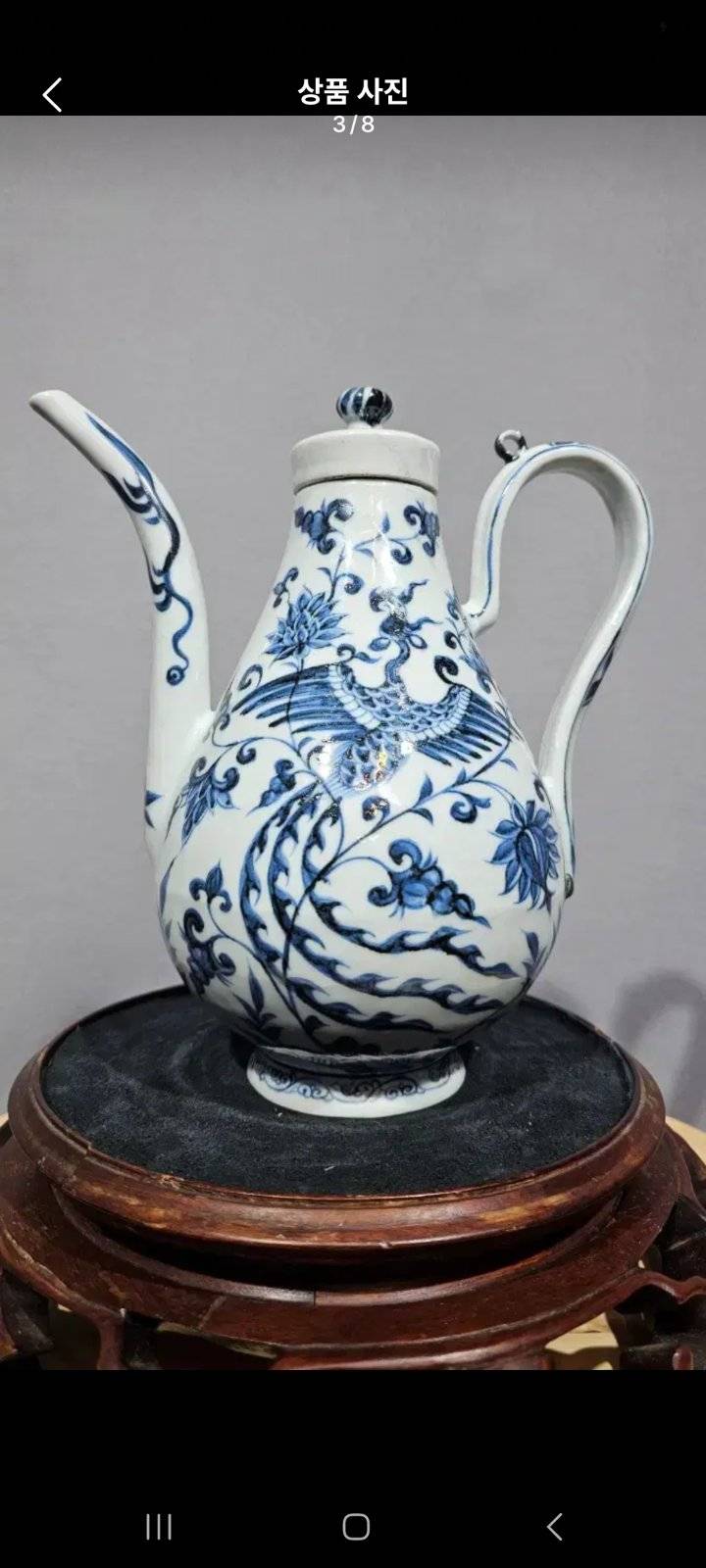
Blue and White Phoenix Ewer
Estimated value
$250 - $650Rarity
Average(4/10)Category
Ceramics & PotteryEra
Late 19th to early 20th CenturyOrigin
ChinaAuthenticity
BLUE AND WHITE PHOENIX EWER: IDENTIFICATION
A pear-shaped ewer (yuhuchun) featuring underglaze blue decoration of a phoenix (fenghuang) among scrolling lotus vines. The vessel is constructed with a curved spout and a loop handle with a small attachment ring for a lid tether. The body is a dense white porcelain, often referred to as 'kaolin-rich' paste, consistent with Jingdezhen style production. The phoenix motif is rendered with segmented wing feathers and a long, flowing tail, typical of Ming and Qing dynasty revival pieces.
SCARCITY
Typical antique shop fare. Requires some searching but regularly available. This is where most genuine antiques fall.
Typical Characteristics
- Standard antique shop items
- Regularly available
- Moderate collector interest
Confidence Factors
- Absence of a reign mark on the base or body suggests a non-imperial production.
- The 'heaping and piling' of the cobalt blue appears somewhat mechanically applied to mimic early Ming styles.
- The footrim exhibits artificial-looking darkening rather than natural 100+ year oxidation.
Expert review recommended. Consider consulting a specialist before making purchasing decisions.
CERAMICIST'S ASSESSMENT
Ceramics Historian & Kiln Specialist
Identification of the form and motif is certain, but dating is cautious due to the high volume of late 19th-century and 20th-century reproductions of this specific style.
KEY EVIDENCE
- 1Pear-shaped 'yuhuchun' form consistent with Ming/Qing transition styles.
- 2Unglazed footrim shows coarse paste with moderate iron spotting.
- 3Cobalt blue displays characteristic 'mottling' intended to mimic earlier Sumali blue.
- 4The presence of a lid tether ring on the handle is a traditional construction detail.
UNCERTAINTIES
- •Lack of a reign mark makes definitive dating to an imperial period impossible.
- •Cleanliness of the interior (visible in some angles) may suggest later production.
WHAT WOULD IMPROVE CERTAINTY
- →Perform a 'tap test' with a wooden dowel to check for dull sounds indicating hidden cracks.
- →Examine the interior for 'chatter marks' or spiral ridges from the potter's wheel.
- →Conduct a UV light inspection to detect modern epoxy repairs on the spout tip.
CONDITION & GRADE
Grading breakdown
The vessel maintains its integrity with no visible cracks or repairs on the spout; however, significant wear on the footrim and surface pinholes lower the grade from 'Fine'.
Condition
Small chips are visible on the unglazed footrim. Notable rust spots (iron oxidation) appear in the blue pigment, which is a common characteristic of older kiln firings but also frequently simulated in later reproductions.
Weight & feel
Estimated weight is approximately 800-1100g, suggesting a solid, mid-weight porcelain body consistent with late Qing export or domestic wares.
CERAMICS MARKET VALUE
Updated: May 11, 2026
Similar unmarked late Qing/Republic era ewers have realized between $300 and $800 at regional auction houses like Christie's South Kensington (2015-2020 archives).
Who buys this
Collectors of Qing Dynasty provincial wares and interior designers seeking classical Asian focal pieces.
What increases value
- •Intact spout and handle, which are the most fragile and frequently repaired parts.
- •Clear, vibrant cobalt blue contrast against the white ground.
What lowers value
- •Hidden cracks (stars) on the base.
- •Attribution as a mid-20th-century reproduction rather than late 19th century.
What makes top-tier examples
- •Authentic Ming-era Sumali blue with natural iron-ageing.
- •Documented Imperial reign marks from the Xuande or Chenghua periods.
Grade & condition
Chipping on footrim, glaze pinholes, and pigment consistency.
Rarity & demand
For informational purposes only, not a formal appraisal.
ABOUT CERAMICS & POTTERY
Pottery, porcelain, stoneware, earthenware, and kiln-fired objects.
Ceramics & Pottery value and rarity guideSHARE THIS CURIOSITY
Have your own curiosities to discover?
Scan Your Curiosity
COMMENTS