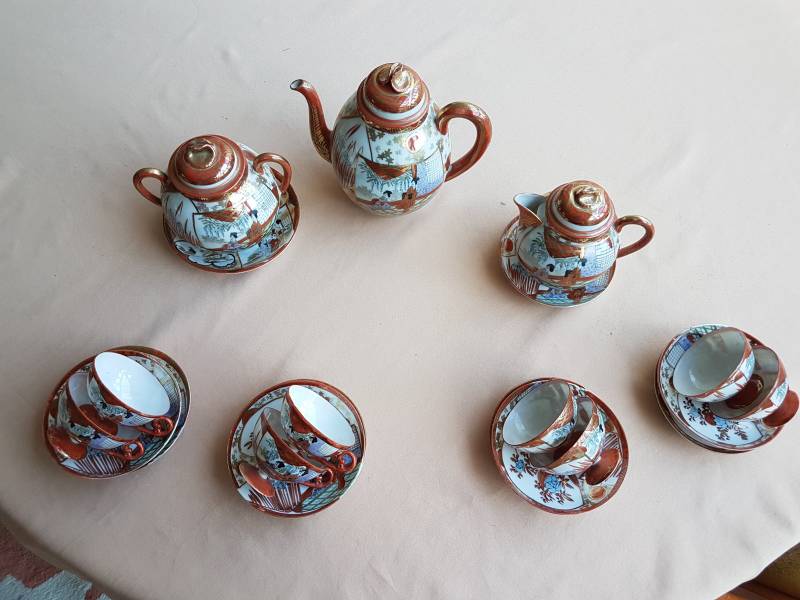
Satsuma Ware Eggshell Porcelain Tea Service, Late Meiji to Early Taisho Period (c. 1900-1920)
Estimated value
$150 - $350Rarity
Average(4/10)Category
Ceramics & PotteryEra
Early 20th Century (1900-1920)Origin
JapanAuthenticity
SATSUMA WARE EGGSHELL PORCELAIN TEA SERVICE, LATE MEIJI TO EARLY TAISHO PERIOD (C. 1900-1920): IDENTIFICATION
A comprehensive Japanese porcelain tea service featuring an 'eggshell' thickness body decorated in the Satsuma style. The set includes a globose teapot with a domed lid, a two-handled sugar bowl, a cream jug, and multiple teacups with matching saucers. The ornamentation consists of hand-painted polychrome enamels and extensive 'moriage' (raised gold) detailing. The primary decorative panels depict Bijin (beautiful women) in interior and garden settings, framed by diaper patterns and floral motifs in iron-red and gold.
PRODUCTION & FIRING
SCARCITY
Typical antique shop fare. Requires some searching but regularly available. This is where most genuine antiques fall.
Typical Characteristics
- Standard antique shop items
- Regularly available
- Moderate collector interest
Confidence Factors
- Typical export-market construction consistent with the early 20th century
- Moriage technique and enamel palette align perfectly with Meiji/Taisho period production
CERAMICIST'S ASSESSMENT
Asian Art Specialist
The identification is based on clearly visible stylistic markers, material thickness, and known export patterns from the Meiji/Taisho transition.
KEY EVIDENCE
- 1Use of iron-red and gold 'moriage' highlights typical of export Satsuma style.
- 2The 'Bijin' (fine ladies) motif is a diagnostic commercial pattern for the 1890-1920 window.
- 3Presence of 'eggshell' translucent porcelain body distinguishes it from earlier earthenware Satsuma.
- 4Handle shapes on the sugar bowl and teapot conform to European service shapes introduced in the Meiji era.
UNCERTAINTIES
- •High frequency of gilt wear may indicate significant domestic use rather than cabinet storage.
WHAT WOULD IMPROVE CERTAINTY
- →Examine the underside of the teapot and cups for a 'Dai Nippon' or 'Made in Japan' mark to narrow the date.
- →Hold the cups toward a strong light to check for a lithophane portrait in the base.
- →Check for hairline cracks in the handle joints using a 10x loupe.
CONDITION & GRADE
Grading breakdown
The set loses value due to moderate gilt loss on high-contact areas like the teapot handle and sugar bowl finial, though the hand-painted panels remain largely intact.
Condition
Visible rubbing and wear to the gold gilding on the handles and rims, common for sets of this age. Minor kiln soot specks are present on the white glaze, indicating original provincial production standards.
CERAMICS MARKET VALUE
Updated: May 11, 2026
Who buys this
Collectors of Japanese export porcelain and enthusiasts of early 20th-century decorative tea services.
What increases value
- •Completeness of the set (presence of all lids and saucers)
- •Clarity and detail of the hand-painted faces in the panels
- •Intensity of the gold 'moriage' decoration
What lowers value
- •Hairline cracks or chips, which are frequent in fragile eggshell porcelain
- •Significant loss of gilding on the handles
- •Incomplete sets (missing lids or cups)
What makes top-tier examples
- •Presence of a high-quality lithophane in the base
- •Signature of a known studio such as Kinkozan or Yabu Meizan
Grade & condition
Condition of the gilding, presence of chips in the thin rims, and the quality of the enamel brushwork.
Rarity & demand
For informational purposes only, not a formal appraisal.
ABOUT CERAMICS & POTTERY
Pottery, porcelain, stoneware, earthenware, and kiln-fired objects.
Ceramics & Pottery value and rarity guideSHARE THIS CURIOSITY
Have your own curiosities to discover?
Scan Your Curiosity
COMMENTS