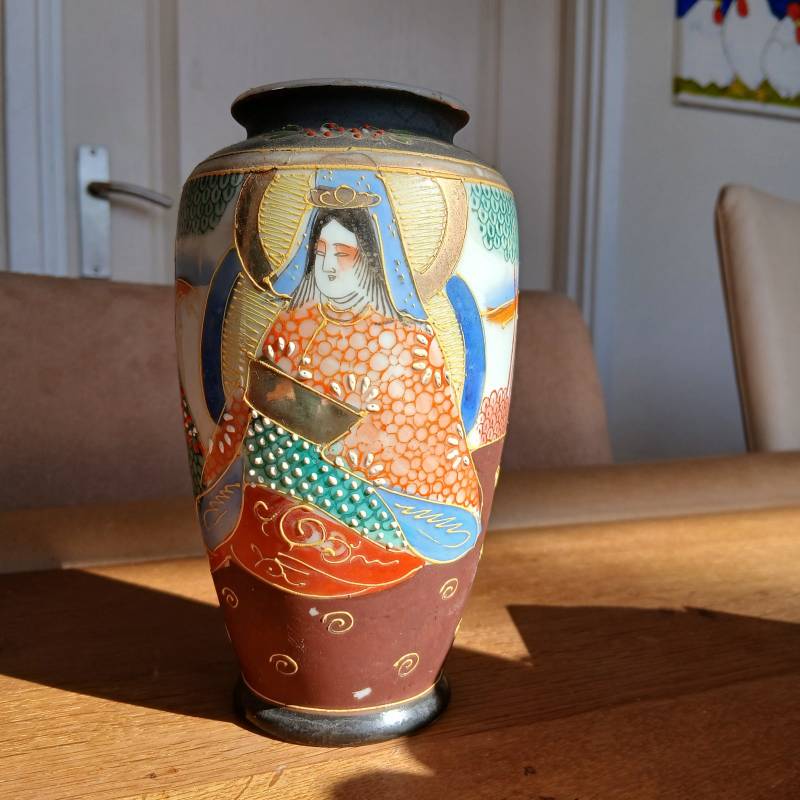
Satsuma-style Moriage Dragon and Arhat Vase
Estimated value
$45 - $120Rarity
Ordinary(3/10)Category
Ceramics & PotteryEra
Circa 1945–1955Origin
JapanAuthenticity
SATSUMA-STYLE MORIAGE DRAGON AND ARHAT VASE: IDENTIFICATION
A Japanese export porcelain vase featuring heavy moriage (slip-trailed) decoration. The central panel depicts a seated female figure, likely Kannon, alongside an Arhat (Buddhist disciple). The decoration utilizes the 'dragon-in-clouds' motif encircling the shoulder, executed with raised enamel dots and gilding. The base shows a white porcelain body finished with a matte iron-red slip on the lower exterior, characteristic of mid-20th century export wares.
PRODUCTION & FIRING
COLLECTOR NOTES
The red bird mark on the base is often associated with the 'Occupied Japan' era (1947–1952), although the specific 'Eagle' stamp was used by various Nagoya-based export companies.
SCARCITY
Standard antiques commonly found at estate sales and flea markets. Plentiful supply meets modest demand.
Typical Characteristics
- Moderate production runs
- Common at estate sales
- Entry-level collectibles
Confidence Factors
- Construction and marks are entirely consistent with mid-20th century Nagoya export wares
- Moriage technique matches period-correct industrial application
CERAMICIST'S ASSESSMENT
Ceramics Historian & Kiln Specialist
High confidence due to the presence of a distinct maker/exporter mark and the highly standardized 'Dragonware' decorative style common in documented catalogs from the 1940s.
KEY EVIDENCE
- 1Presence of 'Eagle' red overglaze mark common to Nagoya export ceramics
- 2Characteristic slip-cast porcelain body rather than traditional Kyoto stoneware
- 3Beaded 'moriage' application typical of the 1930s-1950s export period
- 4Matte iron-oxide slip base finish used to simulate older, more expensive Satsuma wares
UNCERTAINTIES
- •Gilding wear suggests frequent handling or poor storage
- •Lack of 'Made in Occupied Japan' text alongside the bird mark suggests a date slightly before or after 1947–1952
WHAT WOULD IMPROVE CERTAINTY
- →Gently clean the surface with a soft brush to assess enamel stability
- →Examine the interior with a flashlight to check for hairline cracks not visible on the exterior decoration
CONDITION & GRADE
Grading breakdown
Grade assigned due to substantial wear on the cold-painted gold accents and accumulated surface residue, though the porcelain body remains sound.
Condition
Significant loss of gilding on the rim and halo areas; visible surface grime and minor 'flea bites' on the footrim. The moriage beads appear largely intact with no major structural cracks visible.
CERAMICS MARKET VALUE
Updated: May 10, 2026
Similar unmarked or 'bird mark' dragonware vases typically sell on eBay or Etsy for $40–$85; examples in pristine condition with 'Occupied Japan' marks can reach $150 according to WorthPoint data.
Who buys this
General antique collectors, enthusiasts of post-war Japanese 'Dragonware', and interior decorators seeking mid-century Asian accents.
What increases value
- •Completeness of the raised moriage beads
- •Clarity of the maker's mark on the base
- •Vibrancy of the remaining hand-painted enamels
What lowers value
- •Significant gilding loss on the halo and rim reduces aesthetic value
- •Surface dirt and potential hidden fractures in the high-relief areas
What makes top-tier examples
- •Presence of the 'Made in Occupied Japan' stamp
- •Exceptional detail in facial features and fine line work on the dragon scales
Grade & condition
Condition is primarily determined by enamel loss, gilding wear, and chips to the fragile raised beads.
Rarity & demand
For informational purposes only, not a formal appraisal.
ABOUT CERAMICS & POTTERY
Pottery, porcelain, stoneware, earthenware, and kiln-fired objects.
Ceramics & Pottery value and rarity guideSHARE THIS CURIOSITY
Have your own curiosities to discover?
Scan Your Curiosity
COMMENTS