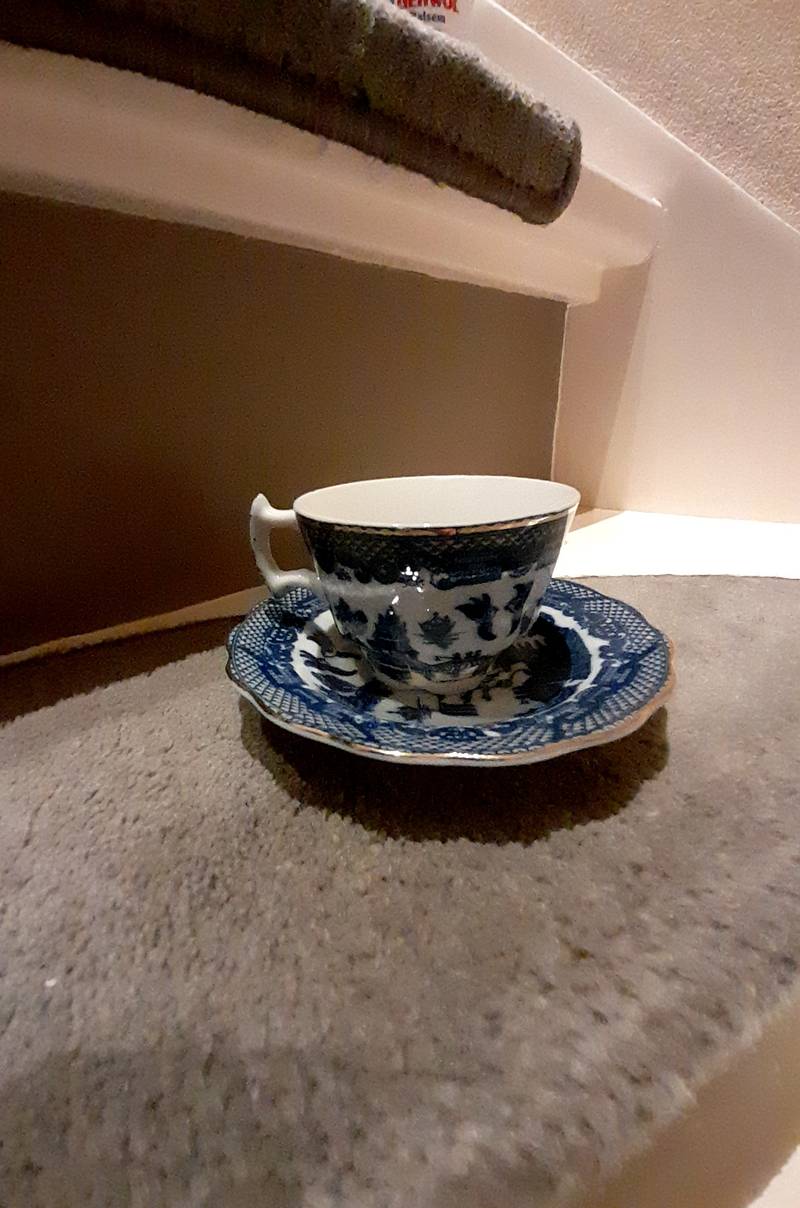
Blue Willow Pattern Teacup and Saucer
Estimated value
$15 - $35Rarity
Ordinary(3/10)Category
Ceramics & PotteryBrand
Unknown Staffordshire PotteryEra
Mid-20th Century, circa 1940-1960Origin
UKAuthenticity
BLUE WILLOW PATTERN TEACUP AND SAUCER: IDENTIFICATION
A transfer-printed ceramic teacup and saucer featuring the traditional Blue Willow pattern. The set exhibits a scalloped rim with gilt (gold) edging and a standard loop handle with a small thumb rest. The central imagery on the saucer includes the hallmark pagoda, bridge with three figures, and two birds in flight, rendered in a deep cobalt blue transfer under a clear glaze.
CROSS-CULTURAL PARALLELS
Where This Object Echoes
The Western interpretation of East Asian artistic traditions that dominated 18th and 19th-century European dekor
Ritual & Ceremonial Use
- •Afternoon tea service in British and American households during the mid-20th century
Meaning Through Time
A luxury status symbol representing exotic trade with the East
An affordable, nostalgic staple of middle-class domestic stability
PRODUCTION & FIRING
SCARCITY
Standard antiques commonly found at estate sales and flea markets. Plentiful supply meets modest demand.
Typical Characteristics
- Moderate production runs
- Common at estate sales
- Entry-level collectibles
Confidence Factors
- Common design frequently reproduced
- Construction and handle style consistent with mid-century mass production
CERAMICIST'S ASSESSMENT
Furniture Historian & Restoration Specialist
The pattern and form are highly recognizable, though the exact manufacturer cannot be confirmed without a backstamp photo.
KEY EVIDENCE
- 1Presence of standard Blue Willow transfer elements (birds, pagoda, bridge)
- 2Scalloped saucer rim with gilt highlights characteristic of post-1940 production
- 3Handle design with 'thumb-rest' spur typical of English mid-market ironstone
- 4Cobalt blue saturation levels consistent with modern transfer printing versus 19th-century flow blue
UNCERTAINTIES
- •Absence of maker mark image makes specific factory attribution impossible
WHAT WOULD IMPROVE CERTAINTY
- →Photograph the underside (backstamp) of both the cup and saucer
- →Check for impressed marks or 'Made in England' stamps
- →Inspect for 'crazing' (fine cracks in the glaze) under direct light
CONDITION & GRADE
Grading breakdown
The transfer remains crisp with minimal bleeding, though value is limited by the common nature of the pattern and lack of a visible high-tier maker's mark.
Condition
The gilt rim shows minor shelf wear typical of handled ceramics; no significant crazing or structural chips are visible on the upper surfaces in the provided images.
CERAMICS MARKET VALUE
Updated: May 10, 2026
Similar single teacup and saucer sets from Johnson Brothers or Churchill typically sell for $15-$25 on eBay and Etsy (2024).
Who buys this
Everyday collectors of blue and white transferware and individuals seeking replacement pieces for vintage dinnerware sets.
What increases value
- •Maker's mark (e.g., Spode or Royal Doulton would command higher prices)
- •Condition of the gold rimming
- •Clarity of the transfer print
What lowers value
- •Hairline cracks or chips often found at the handle join
- •Loss of gilding through dishwasher use
What makes top-tier examples
- •19th-century 'Flow Blue' versions with blurred edges
- •Complete sets with matching teapots and plates
Grade & condition
Chips, cracks, loss of gilding, and the presence of 'crazing' in the glaze.
Rarity & demand
For informational purposes only, not a formal appraisal.
ABOUT CERAMICS & POTTERY
Pottery, porcelain, stoneware, earthenware, and kiln-fired objects.
Ceramics & Pottery value and rarity guideSHARE THIS CURIOSITY
Have your own curiosities to discover?
Scan Your Curiosity
COMMENTS