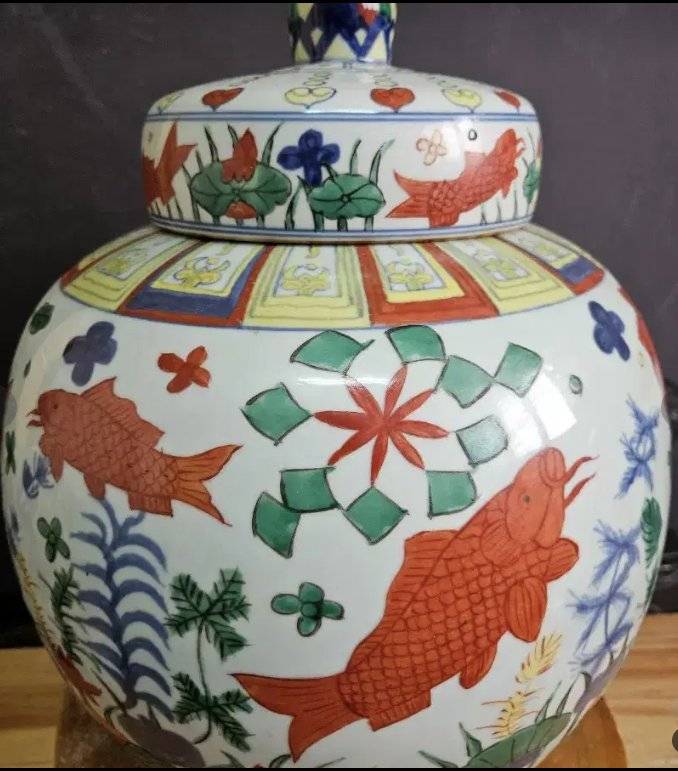
Wucai 'Golden Carp' Ginger Jar with Lid
Estimated value
$80 - $250Rarity
Ordinary(3/10)Category
Ceramics & PotteryEra
Late 20th CenturyOrigin
ChinaAuthenticity
WUCAI 'GOLDEN CARP' GINGER JAR WITH LID: IDENTIFICATION
A porcelain ginger jar decorated in the Wucai palette featuring iron-red golden carp swimming among aquatic plants and lotus. The vessel displays a rounded, globular body with a matching domed cover. The base bears a six-character apocryphal mark in underglaze blue within a double circle reading 'Da Ming Jiajing Nian Zhi' (Great Ming Jiajing Period Made). The decorative scheme utilizes underglaze blue outlines and washes combined with overglaze enamels in red, green, and yellow.
PRODUCTION & FIRING
COLLECTOR NOTES
Authentic 16th-century Jiajing jars of this specific 'Fish' design have reached auction prices exceeding $20 million USD at Sotheby's in 2017.
SCARCITY
Standard antiques commonly found at estate sales and flea markets. Plentiful supply meets modest demand.
Typical Characteristics
- Moderate production runs
- Common at estate sales
- Entry-level collectibles
Confidence Factors
- The Jiajing mark is one of the most frequently faked/reproduced marks in Chinese ceramic history.
- Glaze surface lacks the 'pinholing' and natural degradation expected of 500-year-old porcelain.
- Enamels lack the 'halo' or iridescent oxidation characteristic of 16th-century mineral pigments.
Expert review recommended. Consider consulting a specialist before making purchasing decisions.
CERAMICIST'S ASSESSMENT
Ceramics Historian & Kiln Specialist
Identification is stable as a decorative reproduction based on the quality of the enamel, the crispness of the mark, and the modern glaze sheen which deviates from 16th-century survivals.
KEY EVIDENCE
- 1Six-character Jiajing mark in underglaze blue is written in a standard modern hand rather than the slightly more erratic 16th-century imperial style.
- 2Iron-red enamel is very uniform in tone, suggesting modern chemically-stable pigments rather than traditional ground minerals.
- 3The white ground (body paste) is exceptionally bright and lacks the 'mushy' or slightly gray tone found in older Jingdezhen earth.
- 4Vessel proportions and lid fit are highly standardized, indicative of 20th-century production molds.
UNCERTAINTIES
- •The base mark is too perfect and centered compared to many authentic period examples.
- •Absence of 'chatter marks' or radial lines on the base that typically occur from historical trimming tools.
WHAT WOULD IMPROVE CERTAINTY
- →Inspect the unglazed footrim for 'orange peel' texture or iron spotting.
- →Shine a strong light through the body to check for translucency and consistency of the clay body.
- →Check under UV light for any hidden repairs or modern over-painting.
CONDITION & GRADE
Condition
The glaze appears exceptionally clean with no visible crazing, chips, or surface abrasions. The footrim (not fully visible) would likely show a clean, bleached white paste typical of modern gas-fired kilns.
Weight & feel
Estimated 1.5 to 2.2 kg; likely features a thick-walled body consistent with modern slip-casting or heavy hand-turning.
CERAMICS MARKET VALUE
Updated: May 11, 2026
Who buys this
Home decor enthusiasts and novice collectors looking for traditional Chinese aesthetics without the investment cost of period antiques.
What increases value
- •Overall decorative appeal and color vibrancy
- •Presence of a matching, undamaged cover
What lowers value
- •Large-scale commercial production decreases individual rarity
- •Any chips to the lid or rim significantly reduce its utility as a decor piece
What makes top-tier examples
- •Hand-painted variance in the fish scales vs. uniform stenciling
- •Kiln-fired footrim showing authentic age-related patination
Grade & condition
Surface integrity, enamel thickness, and clarity of the underglaze blue mark.
Rarity & demand
For informational purposes only, not a formal appraisal.
ABOUT CERAMICS & POTTERY
Pottery, porcelain, stoneware, earthenware, and kiln-fired objects.
Ceramics & Pottery value and rarity guideSHARE THIS CURIOSITY
Have your own curiosities to discover?
Scan Your Curiosity
COMMENTS