Chinese Porcelain Dinnerware Set, 'Famille Rose' Style with Birds and Botanicals
Authenticity
CHINESE PORCELAIN DINNERWARE SET, 'FAMILLE ROSE' STYLE WITH BIRDS AND BOTANICALS: IDENTIFICATION
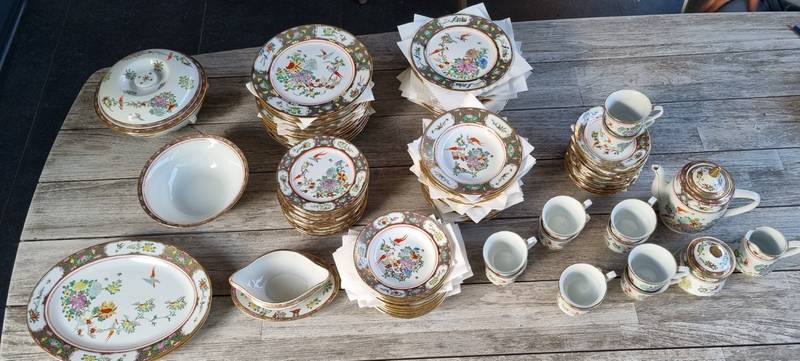
This appears to be a comprehensive dinnerware and tea set in Chinese export porcelain style, richly decorated. The pattern features vibrant 'Famille Rose' (粉彩 - fěncǎi) polychrome enamels depicting a scenic arrangement of exotic birds, likely pheasants or phoenix, amidst flowering chrysanthemums and other dense botanicals. The borders on many pieces exhibit a rich, intricate pattern, possibly a gilded 'Anthemion' or 'Fitzhugh' variant, which frames the central motif beautifully. The gold accents, particularly on the rims and handles, suggest a level of quality intended for export markets.
DYNASTY & PROVENANCE
COLLECTOR NOTES
The 'Famille Rose' (literally 'Rose Family') palette was named by French art historian Albert Jacquemart in 1862 for its dominant opaque pink enamel, which was derived from colloidal gold and allowed for a much softer, more nuanced range of colors than previous enamels.
SCARCITY
Typical antique shop fare. Requires some searching but regularly available. This is where most genuine antiques fall.
Typical Characteristics
- Standard antique shop items
- Regularly available
- Moderate collector interest
Confidence Factors
- Lack of visible maker's marks or reign marks, which limits precise dating and attribution.
- The style is broadly decorative and has been reproduced across several periods, making it difficult to pinpoint exact age without physical inspection or detailed marks.
- Quality of gilding and enamel application can vary widely in export wares, and details of craftsmanship are hard to assess from images.
ASIAN ART SCHOLAR'S TAKE
Asian Art Specialist
Confidence is moderate due to the lack of visible identifying marks and the broad period over which such 'Famille Rose' style export wares were produced. While the style is clearly Chinese export, pinpointing the exact period and value without marks is challenging.
KEY EVIDENCE
- 1The extensive nature of the set, including various dinner and tea service pieces, suggests a full-service production for a substantial household.
- 2The 'Famille Rose' enamel palette with vibrant polychrome decorations of birds and botanicals is characteristic of Chinese export wares.
- 3The intricate gilded borders and gold accents are typical of porcelain made for Western markets, reflecting European design preferences.
- 4The general shape and style of the pieces, such as the lidded tureen and teapot, align with forms popular in 19th and 20th-century Western dining.
UNCERTAINTIES
- •Absence of clear reign marks or other definitive factory markings on the undersides of the pieces, which would aid in precise dating.
- •The exact hue and texture of the gilding are difficult to assess from photos, which can hint at the age (e.g., mercurial vs. electroplated gold).
- •Possible variations in craftsmanship or design within the set are not fully discernible, which could indicate a set assembled from different origins or periods.
WHAT WOULD IMPROVE CERTAINTY
- →Examine all undersides of the pieces for any maker's marks, reign marks, or impressed stamps, and photograph them clearly.
- →Provide close-up images of the rim borders and any painted details to assess the quality of the enamel application and gilding more precisely.
- →Measure a few key pieces (e.g., dinner plates, teapot height) to gain a better understanding of the scale and type of service.
- →Check for any signs of repair or restoration, particularly on handles, spouts, or lids, which might be subtle from the present images.
CONDITION & GRADE
Condition
Visually, the set appears to be in good overall condition. Minor wear to the gilding is expected for a set of this age, particularly on high-use areas like rims and handles, but no major chips or cracks are immediately visible from the images. The enamels retain their vibrancy.
ASIAN ART VALUATION
Updated: Feb 27, 2026
- Market comparables from auctions & retail
- Condition, completeness & craftsmanship
- Current collector demand & trends
- Low = quick sale, high = patient seller
For informational purposes only, not a formal appraisal.
ABOUT ASIAN ART
Chinese, Japanese, Korean, and other Asian art and antiques.
Asian Art value and rarity guideSHARE THIS CURIOSITY
Have your own curiosities to discover?
Scan Your Curiosity
COMMENTS