
Flemish Brass Crusie Lamp with Bird Finial - c. 18th-19th Century
Visual assessment
Photo analysis
Save to revisit in your watchlist. This does not add the object to your own collection.
Flemish Brass Crusie Lamp
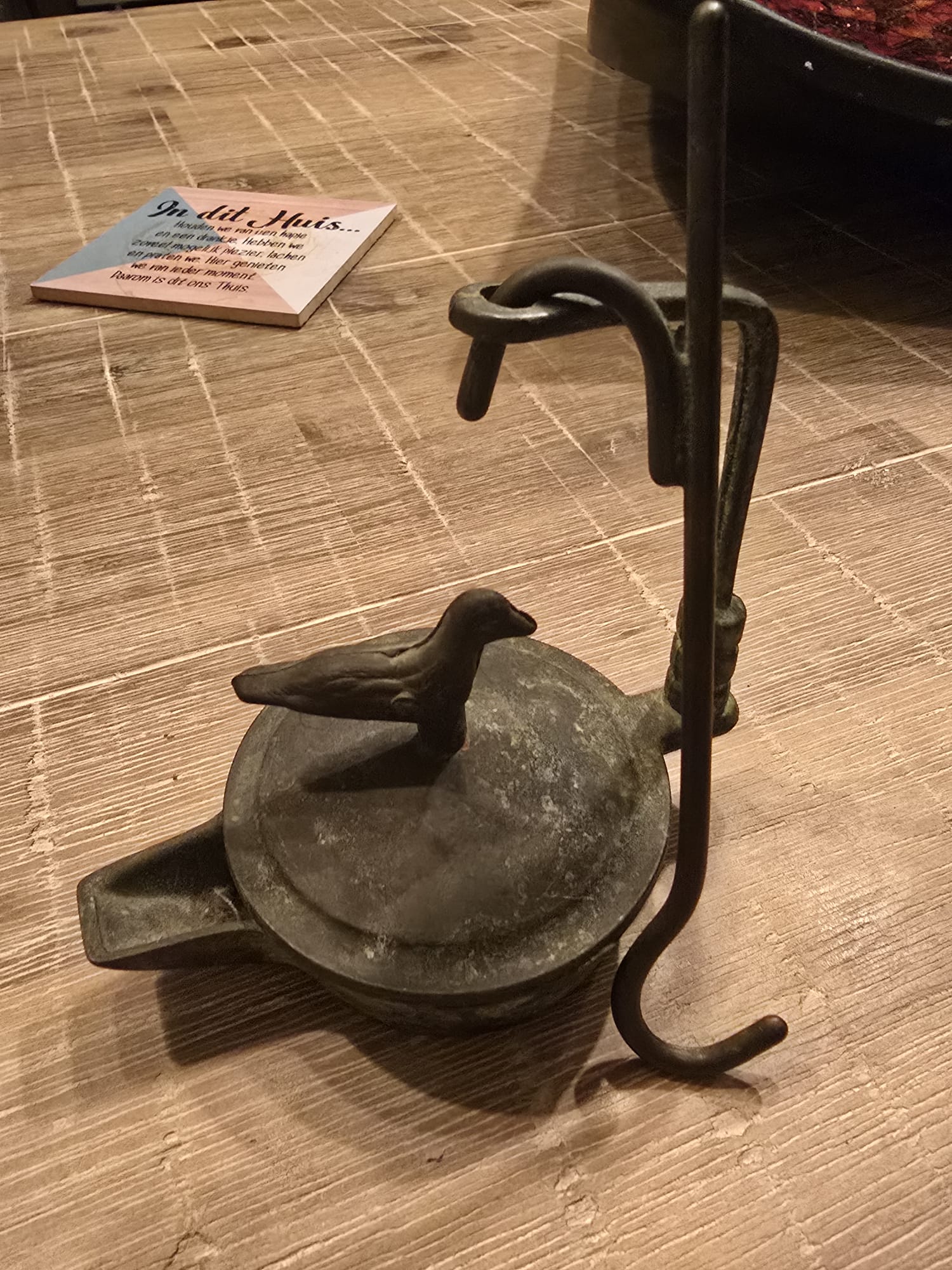
A cast brass 'crusie' style oil lamp featuring a circular oil reservoir, a channelled wick snout, and a distinctive bird-shaped finial on the lid. The assembly includes a vertical support rod with a curved suspension hook and a gimbal-like secondary hook, allowing the lamp to remain level while suspended. The metal shows a heavy oxidation and uneven verdigris patina consistent with prolonged exposure to tallow or whale oil combustion.
Related traditions
Dutch/Flemish Colonial
17th-18th Century
Similar brass lamps were exported to New Amsterdam (early New York) as primary lighting tools for settlers.
Use and ceremony
18th Century
A necessary utilitarian object for night labor and family gathering.
21st Century
An ethnographic antique representing pre-industrial domestic life and technical evolution.
Origins and context
Originating in Northern Europe, specifically the Low Countries (Belgium/Netherlands), these lamps were the primary source of domestic lighting from the late 17th through the mid-19th century. The 'crusie' represents a transition in lighting technology from simple open-bowl lamps to semi-closed systems designed to minimize oil spillage and smoky wicks. According to the Rijksmuseum collection data, bird finials were common decorative motifs in Flemish domestic metalwork throughout the 1700s.
Further details
The bird finial on these lamps often doubled as a handle to lift the lid, which was frequently stuck due to the cooling of congealed animal fats used as fuel.
Similar oil lamps were recorded in Dutch master paintings of the 17th century, where they symbolized domestic industry and the 'flicker of life' in vanitas still lifes.
Attribution and evidence
The object perfectly matches the technical typology of Flemish lighting tools, though the lack of marks and the prevalence of late 19th-century revivals necessitates some caution.
Identifying details
- 1Cast brass construction with evidence of hand-finishing on the bird motif
- 2Functional suspension system with characteristic Flemish 'crusie' silhouette
- 3Authentic accumulation of combustion residue on the wick-end of the reservoir
- 4Gimbal-style hanging hook allows for self-leveling, a hallmark of portable 18th-century lighting
Open questions
- •Modern high-reproduction rate of this style in the mid-20th century as garden ornaments
- •Lack of visible maker's marks, though common for this era and region
Photographs that would help
- Examine the hinge pin for evidence of modern machine-drawn wire versus hand-forged pins
- Conduct a UV light test to see if surface deposits fluoresce, which can distinguish old fats from modern dyes
Wear and preservation
Not applicable to this category of early domestic metalwork; value is driven by patina integrity and completeness of the hanging hardware.
Significant surface buildup and oxidation are present; the bird finial appears intact, though the hinge mechanism for the lid shows signs of stiffness and metal fatigue. No major structural fractures are visible on the oil reservoir or the hanging assembly.
Materials and construction
The surface exhibits a dark, crusty oxidation layer with localized patches of green verdigris and a matte, soot-dulled finish typical of brass exposed to high heat and organic fuels.
Recorded physical details
Estimated weight is approximately 0.6 kg to 0.9 kg given the density of cast brass and the thickness of the vertical suspension rod.
Scarcity and surviving examples
Average · 4/10 estimated rarity
This is a qualitative collection score, not a measured survival count, market percentile or proof of authenticity.
What the photographs establish
Interpretation of the photographs and supplied context. This does not authenticate the object.
- Construction and casting seams align with 18th/19th-century sand-casting methods
- Patina appears layered and organic rather than chemically induced
- Design is a known standard regional type with frequent auction appearances (Catawiki 2023)
Value and its basis
Estimate recorded: May 11, 2026
How we estimate value
Estimate context (not a documented sale): Similar Flemish brass oil lamps with bird motifs consistently realize between 80 and 200 EUR on Catawiki and at regional European auctions (2022-2024).
Collectors and interest
Collectors of early lighting (The Rushlight Club members) and enthusiasts of Continental European folk art.
What supports the estimate
- •The presence of the bird finial, which is more desirable than plain handle versions
- •Completeness of the original hanging rod and leveling hook
What could change it
- •Internal pitting or hidden cracks in the reservoir which reduce utility
- •Evidence of harsh chemical cleaning that removes original oxidation
Comparing quality
- •Clearly defined feathers in the casting of the bird finial
- •Documented 18th-century provenance or association with a known Dutch metalworking guild
The effect of condition
Completeness of components, sharpness of cast details, and quality of the tiered patina.
Market interest
For informational purposes only, not a formal appraisal.
Related objects

Flemish or Dutch Oak Foot Warmer (Stoof) - c. late 19th Century
Shared title details
French Gilt Brass Miniature Book-Form Vesta Case
Same category

Victorian Marcel Curling Tongs (Hair Styling Iron)
Same category

Louis XV Style Fauteuil à la Reine
Same category

Mission Style Oak Dutch Cupboard (Kast)
Same category

Continental Pewter Baluster Measure - 'Lidded Pinte' (Acorn Thumbpiece) c. 1820-1860
Same category
Explore Antiques
Objects over 100 years old with historical and aesthetic value.
Antiques value and rarity guideShare this find
A place for your antiques
Keep its photographs, maker’s marks and the story you know in one object record. Start with a photo.
Create an account for 10 free scans. No credit card needed.
Join the conversation