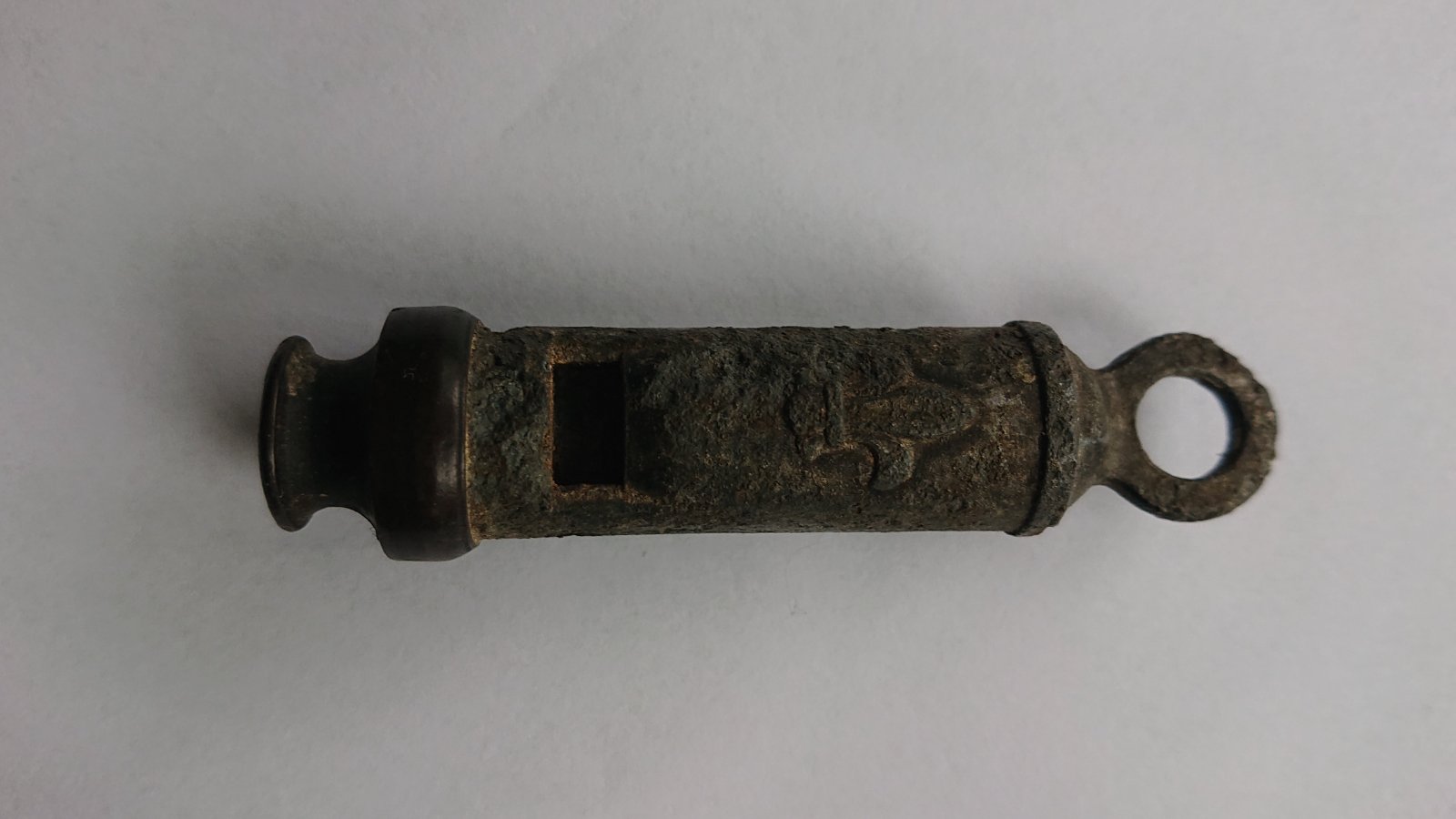
Antique Metal Whistle with Fleur-de-lis Motif
QUICK FACTS
Categories
Era
Late 19th - Early 20th Century
Rarity
Uncommon (5/10)
Discovered
Mar 1, 2026
Today
DESCRIPTION
This appears to be a historic, possibly brass or bronze, tubular whistle, characterized by its aged patination and the presence of a square sound aperture. A decorative motif, which visually approximates a fleur-de-lis, is subtly cast or engraved into its surface, suggesting either a military or perhaps ceremonial association. The form factor, typical of early metallic whistles, is completed by an integrated suspension loop at one end and a shaped mouth opening at the other, hinting at its use as an accessory for signaling or authority.
CULTURAL ECHOES
Where This Object Echoes
The widespread use of whistles for communication, signals, and as personal items, often made from brass or similar metals, was common.
Whistles were integral signaling devices, each with specific designs for different ranks or purposes. The robust construction and suspension loop align with practical utility.
Ritual & Ceremonial Use
- •Signaling in various forms, from calling for assistance, alerting to danger, or commanding attention in public or organized settings.
- •Symbolic use as an emblem of authority, such as for police or railway guards.
Meaning Through Time
Primarily used for music, hunting calls, or rudimentary communication over short distances.
Mass-produced metal whistles become essential tools for law enforcement, military, railways, and sports, symbolizing order and communication.
HISTORICAL STORY
DID YOU KNOW?
The first modern whistle, designed for uniform tone and volume, was invented by Joseph Hudson in Birmingham, England, in 1883 for the London Metropolitan Police, revolutionizing urban signaling.
Early whistles, long before their metal counterparts, were often made from natural materials like hollow reeds, carved animal bones, or even seed pods, producing diverse sounds for communication, ceremony, or hunting.
MATERIAL & CONDITION
Surface
The surface exhibits a coarse, irregular texture, heavily encrusted with a dark, greenish-brown patina indicative of significant oxidation over time. Some areas appear smoother where the original metal might be more exposed, but the overall presentation is one of considerable age and exposure to environmental elements. The motif is indistinct due to this surface degradation.
Weight & Feel
Based on its metallic composition and solid, tubular form, this whistle would likely feel substantial and dense in the hand, weighing more than a modern plastic or aluminum equivalent. The brass or bronze material would contribute to a noticeable heft.
Condition
The object is heavily patinated with significant surface corrosion (verdigris). While structurally intact, the heavy oxidation obscures finer details and affects its original luster. The 'mint' condition stated by the user conflicts with the visual evidence of considerable age and surface degradation.
RARITY ANALYSIS
Genuine antiques with fewer examples on the market. Named makers, documented provenance, or early production examples.
Typical Characteristics
- Limited production
- Named makers
- Growing collector demand
EXPERT ANALYSIS
Cabinet of Curiosities Generalist
Confidence is good as the object's form factor and material consistency strongly suggest an antique metal whistle. However, the heavy patination limits details for precise dating or attribution, leading to a slight reduction in overall confidence.
KEY EVIDENCE
- 1Heavy, dark green-brown patination typical of aged copper alloy (brass or bronze).
- 2Tubular, single-chamber design with a square sound aperture, characteristic of early metal whistles.
- 3Integrated suspension loop, suggesting it was designed to be carried or attached.
- 4Subtle raised motif resembling a fleur-de-lis, pointing to potential cultural or organizational significance.
- 5Flared mouthpiece, a common feature in both simple and more complex whistle designs.
UNCERTAINTIES
- •The extreme patination makes identification of finer details, such as potential maker's marks, difficult.
- •The specific design of the 'fleur-de-lis' is obscured, making its precise meaning or origin speculative without clearer imagery.
- •Absence of scale makes precise size and thus functional context (e.g., small charm vs. practical implement) challenging to ascertain.
WHAT WOULD IMPROVE CERTAINTY
- →High-resolution close-up photographs from all angles to better visualize any obscured markings or design intricacies.
- →Precise measurements (length, diameter) to better understand its potential function and compare with known examples.
- →Careful, non-invasive cleaning of a small, discreet area to potentially reveal underlying metal color or clearer marks, if advisable by a conservator.
- →A magnet test to determine if it is purely non-ferrous (suggesting brass/bronze) or contains iron core.
ESTIMATED VALUE
Updated: Mar 1, 2026
- Market comparables from auctions & retail
- Condition, completeness & craftsmanship
- Current collector demand & trends
- Low = quick sale, high = patient seller
For informational purposes only, not a formal appraisal.
CONTEXT ANALYSIS
How your provided context compares with Curiosa.com scanner findings.
What Aligned
- User believes item is 'Original/Authentic', which aligns with visual evidence of age and material degradation consistent with a genuine antique.
What Conflicted
- User described condition as 'Mint', which conflicts strongly with the visible heavy patination, corrosion, and overall aged appearance of the whistle's surface.

SHARE THIS CURIOSITY
Have your own curiosities to discover?
Scan Your Curiosity
COMMENTS
No comments yet. Be the first to share your thoughts!
Sign in to leave a comment