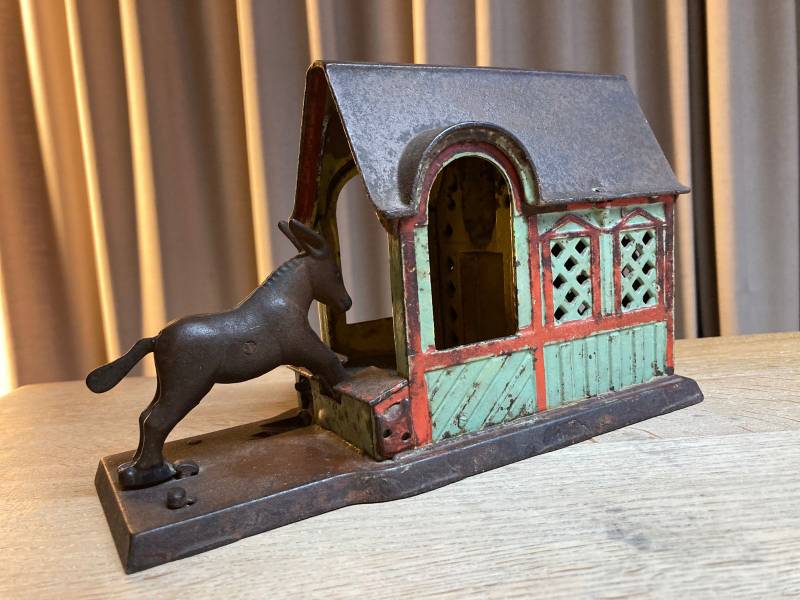
Donkey in Action Cast Iron Mechanical Bank - "Butting Goat" style
Estimated value
$400 - $1,200Rarity
Uncommon(5/10)Category
Toys & GamesBrand
J. & E. Stevens Co. (attributed)Era
Circa 1880-1920Origin
United StatesArtist / Creator
James H. Bowen (Designer)Authenticity
DONKEY IN ACTION CAST IRON MECHANICAL BANK - "BUTTING GOAT" STYLE: IDENTIFICATION
This appears to be a vintage cast iron mechanical bank, likely modeled after the popular 'Butting Goat' bank mechanism but featuring a donkey instead. The bank depicts a rustic building, possibly a barn or house, with a donkey positioned to 'butt' a coin inserted into a slot. These mechanical banks were designed not just for saving money, but also for entertaining children and demonstrating simple mechanical principles.
COLLECTOR NOTES
Many mechanical banks were patented between 1870 and 1900, marking a golden age for these inventive toys that combined entertainment with financial education.
SCARCITY
Genuine antiques with fewer examples on the market. Named makers, documented provenance, or early production examples.
Typical Characteristics
- Limited production
- Named makers
- Growing collector demand
Confidence Factors
- Cast iron mechanical banks were widely reproduced, making careful examination of casting quality and date marks crucial.
- The extent of paint wear makes it difficult to ascertain if any portions have been repainted or touched up over time without UV testing.
- While the 'PAT'D' marking is visible, a clear patent date or manufacturer's name is not fully legible, which would assist in definitive attribution.
TOY SPECIALIST'S TAKE
Toy Historian & Collector-Dealer
High confidence is based on the clear identification of the object as a cast iron mechanical bank from the late 19th/early 20th century, with visible period-appropriate construction and markings. The primary ambiguity lies in pinpointing the exact manufacturer and model variant without clearer base markings.
KEY EVIDENCE
- 1Cast iron construction indicative of vintage mechanical banks.
- 2Visible 'PAT'D' marking on the base, pointing to an original patent.
- 3Design and paint wear pattern consistent with late 19th to early 20th-century production.
- 4The presence of a turning mechanism suggests a mechanical bank, even if the specific action is not fully demonstrated.
- 5Bottom plate with perforated holes and a circular cover, typical for coin removal.
UNCERTAINTIES
- •Specific manufacturer and exact model name are not clearly legible from the images.
- •The exact functionality of the mechanical action cannot be confirmed from photos alone.
WHAT WOULD IMPROVE CERTAINTY
- →A clear, well-lit photograph of the base showing all legible markings, especially around the 'PAT'D' section and the screw mechanism.
- →A short video demonstrating the mechanical action when a coin is placed.
- →UV light test on the painted surfaces to check for any repaint or touch-ups.
- →Measurement of the bank's dimensions to compare with known examples.
CONDITION & GRADE
Condition
The bank shows considerable paint loss, consistent with age and use. The mechanical action appears to be present, though its full functionality cannot be verified without a hands-on inspection. There's surface rust, but it seems to be stable and not actively corroding major structural components. The bottom plate is present, with some markings visible.
TOY MARKET VALUE
Updated: Feb 27, 2026
- Market comparables from auctions & retail
- Condition, completeness & craftsmanship
- Current collector demand & trends
- Low = quick sale, high = patient seller
For informational purposes only, not a formal appraisal.
ABOUT TOYS & GAMES
Vintage toys, dolls, board games, action figures, and childhood collectibles.
Toys & Games value and rarity guideSHARE THIS CURIOSITY
Have your own curiosities to discover?
Scan Your Curiosity
COMMENTS