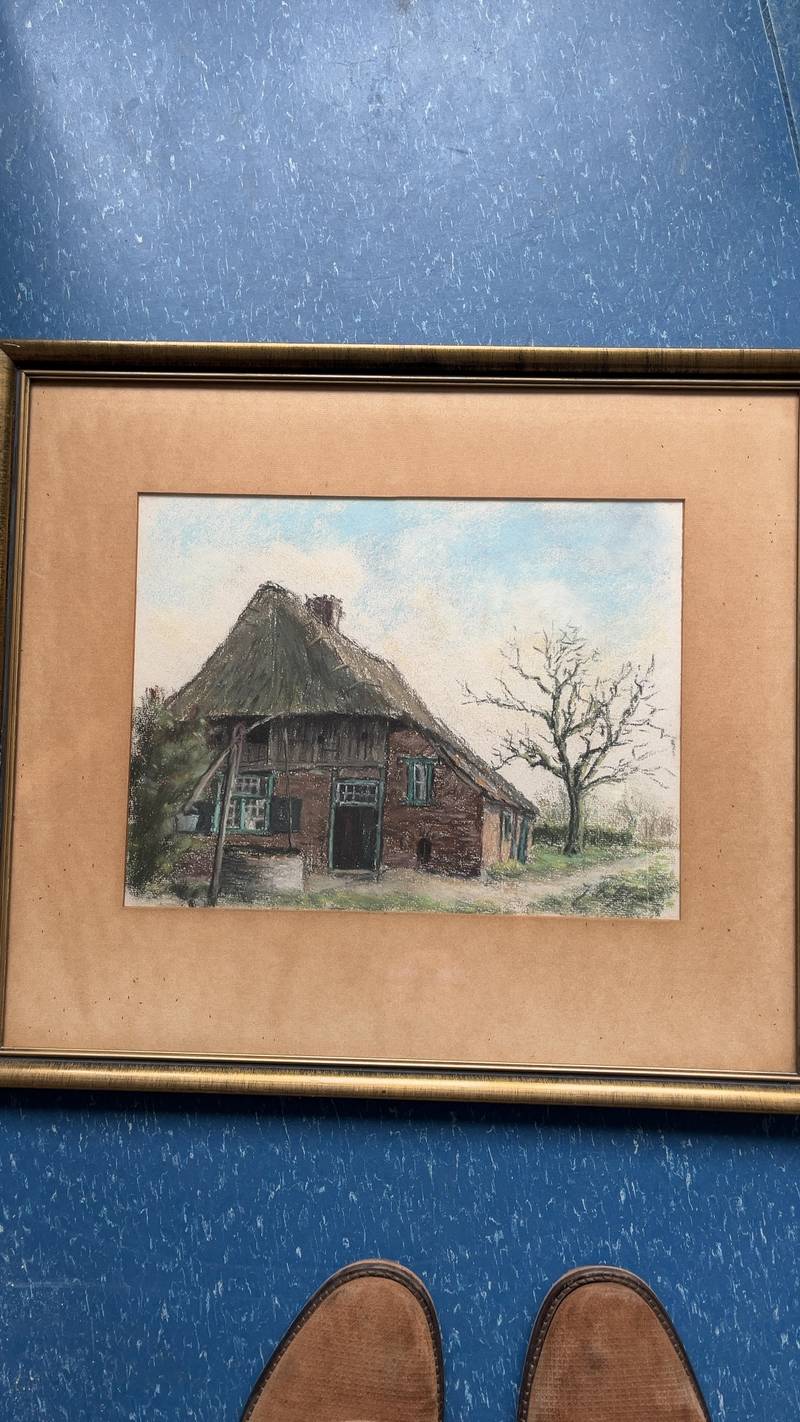
Pastel Drawing of a Dutch Thatched Farmhouse, Manner of the Hague School
Authenticity
PASTEL DRAWING OF A DUTCH THATCHED FARMHOUSE, MANNER OF THE HAGUE SCHOOL: IDENTIFICATION
A landscape execution in soft pastel and charcoal on textured paper, depicting a rural Dutch 'boerderij' (farmhouse) with a prominent thatched roof and a sweep-well. The artist utilizes a restricted palette of earth tones—umber, sienna, and deep greens—contrasted with a pale Cerulean sky. The architecture features traditional timber-framing details and green-painted shutters typical of the Low Countries' rural vernacular.
CROSS-CULTURAL PARALLELS
Where This Object Echoes
The depiction of the 'boerderij' as a symbol of national identity and rural grit.
Ritual & Ceremonial Use
- •The daily gathering of water at the well-sweep, a central social and functional ritual of European rural life before indoor plumbing.
Meaning Through Time
A literal representation of a working-class dwelling and poverty.
An object of nostalgia and a romanticized view of 'slow' pre-industrial life.
PRODUCTION PERIOD
SCARCITY
Typical antique shop fare. Requires some searching but regularly available. This is where most genuine antiques fall.
Typical Characteristics
- Standard antique shop items
- Regularly available
- Moderate collector interest
Confidence Factors
- Lack of visible signature or monogram on the face of the work
- Standardized subject matter common in both period works and later stylistic revivals
- Modern framing prevents inspection of the paper reverse for watermarks or labels
SPECIALIST ASSESSMENT
Museum-Trained Art Historian
The style, medium, and subject matter are clearly identifiable as Dutch regionalism, but the lack of a visible signature limits the ability to provide a definitive artist attribution.
KEY EVIDENCE
- 1Traditional Dutch 'putgalg' (well-sweep) construction visible in foreground
- 2Textured paper provides a ground consistent with early 20th-century pastel studies
- 3Tonalist palette reflects the influence of Jozef Israëls or Anton Mauve
- 4Thatched roof depicts the specific 'dekriet' (water reed) layering technique typical of North Holland or Overijssel
UNCERTAINTIES
- •The black specks (likely frass) indicate a breach in the frame's seal or an active biological presence in the past
- •Lack of signature makes attribution to a specific listed artist difficult without provenance
WHAT WOULD IMPROVE CERTAINTY
- →Examine the reverse of the frame for gallery labels or auction house chalk marks
- →Remove the artwork from the acidic matting to prevent 'mat burn' and check for a hidden signature
- →Check for a watermark on the paper by held-to-light inspection once unframed
CONDITION & GRADE
Grading breakdown
The artwork is well-preserved with no visible foxing or moisture tidelines, though the matting appears to be non-archival acidic board which may cause future discoloration at the edges.
Condition
The paper support shows signs of oxidation and light-toning consistent with age. There are several dark specks visible under the glass, likely 'frass' (insect debris) or small particulate matter trapped between the mat and the artwork. The pastel appears stable with no significant pigment transfer to the glass.
Weight & feel
The object is lightweight, approximately 1.5 kg including the modern gilt-wood frame and glazing.
MARKET VALUATION
Updated: May 10, 2026
Unsigned pastel studies of this type typically realize between $200 and $500 at regional European auctions (e.g., Venduehuis der Notarissen, 2023).
Who buys this
Collectors of Dutch regional art and interior designers looking for 'Old World' atmospheric landscapes.
What increases value
- •Authenticity of the period frame
- •Draftsmanship quality in the bare tree branches and texture of the thatch
- •Historical accuracy of the rural architecture
What lowers value
- •Anonymity of the artist
- •Acidic damage from the current matting
- •Evidence of insect frass potentially affecting the paper
What makes top-tier examples
- •Inclusion of a prominent signature from a known Hague School master
- •Exceptional preservation of the fugitive pastel pigments
- •Documented provenance from a recognized European gallery
Grade & condition
Paper integrity, pigment stability, and absence of foxing or biological degradation.
Rarity & demand
For informational purposes only, not a formal appraisal.
ABOUT DECORATIVE OBJECTS
Silver, glassware, metalwork, enamelwork, and decorative arts.
Decorative Objects value and rarity guideSHARE THIS CURIOSITY
Have your own curiosities to discover?
Scan Your Curiosity
COMMENTS